Increasing Crop Yields by The Power of Native Pollinators
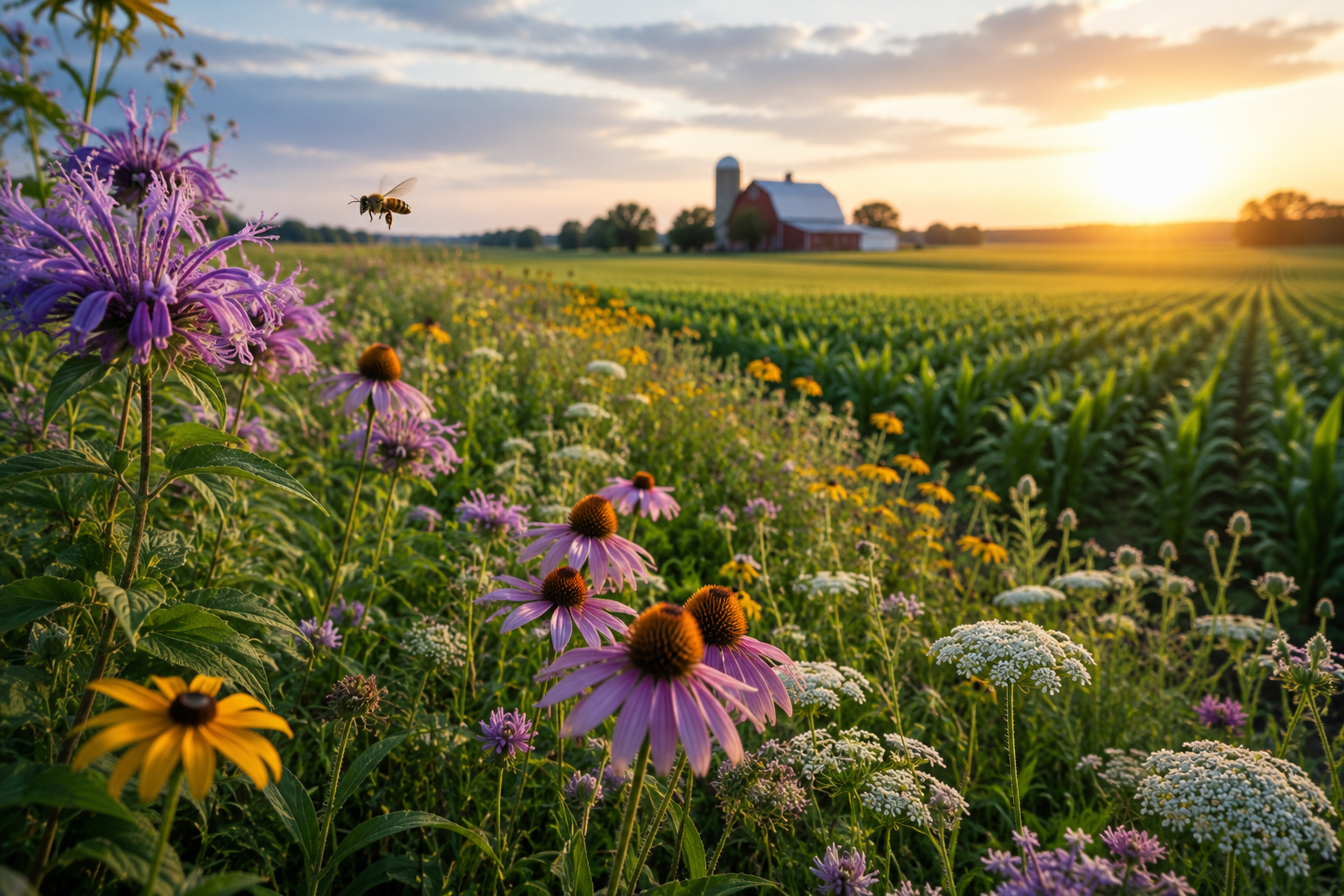
An artistic Image showing a wildflower planting next to a field of row crops
For decades, agricultural innovation has focused on fertilizers, irrigation, pesticides, genetics, and machinery. These tools have dramatically increased productivity, but one of the most powerful yield-boosting resources has often been overlooked: native pollinators.
Across Kansas and much of North America, populations of native bees, butterflies, moths, beetles, flies, and other pollinating insects have declined due to habitat loss, pesticide exposure, and landscape fragmentation. At the same time, many farmers have become increasingly dependent on managed honeybee colonies to pollinate crops.
Yet research and on-farm observations suggest that restoring native pollinator habitat may be one of the most cost-effective ways to improve crop production while strengthening the resilience of agricultural systems.
Pollination Is an Agricultural Input
Many people think of pollinators as a conservation issue, but they are also an agricultural resource.
Pollination directly affects fruit set, seed production, crop quality, and yield in many crops. Fruits, berries, melons, squash, pumpkins, nuts, and numerous vegetable seed crops all depend on pollinating insects.
Even crops that do not require insect pollination often benefit indirectly from healthy pollinator populations because pollinator habitat supports broader biodiversity, including predatory insects that help control pests.
Pollinators should be viewed as living agricultural infrastructure.
Native Pollinators Are Often Better Than Honeybees
Honeybees receive most of the attention because they are managed commercially, but North America is home to thousands of native pollinator species.
Many native bees are more efficient pollinators than honeybees for specific crops. Bumblebees can pollinate in cooler temperatures and lower light conditions. Mason bees and leafcutter bees are highly effective pollinators of fruit crops. Specialist bees have evolved alongside native plants and can provide pollination services that honeybees cannot.
Unlike rented honeybee hives, native pollinators work for free when suitable habitat exists.
Habitat Creates Yield
One of the simplest ways to increase pollinator populations is to provide them with places to live.
Native flowering plants along field margins, drainage ditches, shelterbelts, wetlands, roadsides, and unused corners of farms can provide pollen and nectar throughout the growing season.
Habitat does not need to occupy productive farmland. Often, the least profitable areas of a field are the most valuable places for pollinator plantings.
Native wildflowers, shrubs, and trees create a continuous food supply that allows pollinator populations to survive year after year.
Over time, these habitat corridors become reservoirs of beneficial insects that spread throughout the surrounding landscape.
Host Plants Matter
Conservation efforts often focus on nectar-producing flowers, but many insects require specific host plants to complete their life cycles.
Monarch butterflies need milkweed. Numerous moths and butterflies depend on native grasses, wildflowers, shrubs, and trees. Specialist bees may collect pollen from only a handful of plant species.
Without host plants, adult pollinators may visit flowers but fail to reproduce.
Restoring native host plants creates permanent pollinator populations rather than temporary visitors.
In the Great Plains, species such as milkweed, prairie clovers, blazing stars, goldenrods, sunflowers, asters, willows, and native grasses support a remarkable diversity of insects.
Pollinator-Friendly Pest Management
Pesticides remain an important tool for many farmers, but application methods can greatly influence pollinator survival.
Simple changes can significantly reduce unintended impacts:
• Avoid spraying blooming plants whenever possible.
• Apply products during evening or nighttime hours when pollinators are less active.
• Reduce drift through proper nozzle selection and weather monitoring.
• Use targeted treatments instead of broad-spectrum applications when feasible.
• Adopt integrated pest management strategies that reduce unnecessary spraying.
These practices help maintain pollinator populations while still protecting crops from economically significant pests.
Pollinators and Regenerative Agriculture
Many regenerative farming practices naturally support pollinator communities.
Cover crops provide forage during periods when cash crops are not blooming. Agroforestry systems add flowering trees and shrubs. Rotational grazing creates habitat diversity. Wetland restoration supports both aquatic insects and pollinators.
These systems often generate multiple benefits simultaneously: improved soil health, reduced erosion, greater biodiversity, enhanced water retention, and increased pollination.
Rather than treating conservation and agriculture as competing goals, regenerative approaches recognize that ecological function often improves farm productivity.
The Economics of Biodiversity
Farmers frequently evaluate investments based on return per acre. Pollinator habitat should be viewed through the same lens.
A strip of native flowers may occupy a small portion of a farm, but if it increases yields across surrounding acreage, the return can exceed that of many conventional inputs.
Unlike fertilizer or pesticides, pollinator habitat is a long-term investment that can continue producing benefits for decades once established.
Healthy pollinator populations provide ecosystem services every growing season without annual purchase costs.
Building Farms That Work with Nature
The future of agriculture will require producing more food while using resources more efficiently.
Native pollinators offer a powerful example of how ecological restoration and agricultural production can work together. By restoring habitat, protecting host plants, adopting pollinator-friendly management practices, and embracing biodiversity as an agricultural asset, farmers can strengthen both their operations and the landscapes that support them.
The lesson is simple: nature is not merely something that exists around farms. When managed wisely, it becomes one of the most productive tools a farmer can have.
Increasing crop yields may not always require more chemicals, more machinery, or more land. Sometimes it begins with creating space for the insects that have been helping plants reproduce for millions of years.