

Why Kansans Often Prefer Farms to Solar Farms and Data Centers
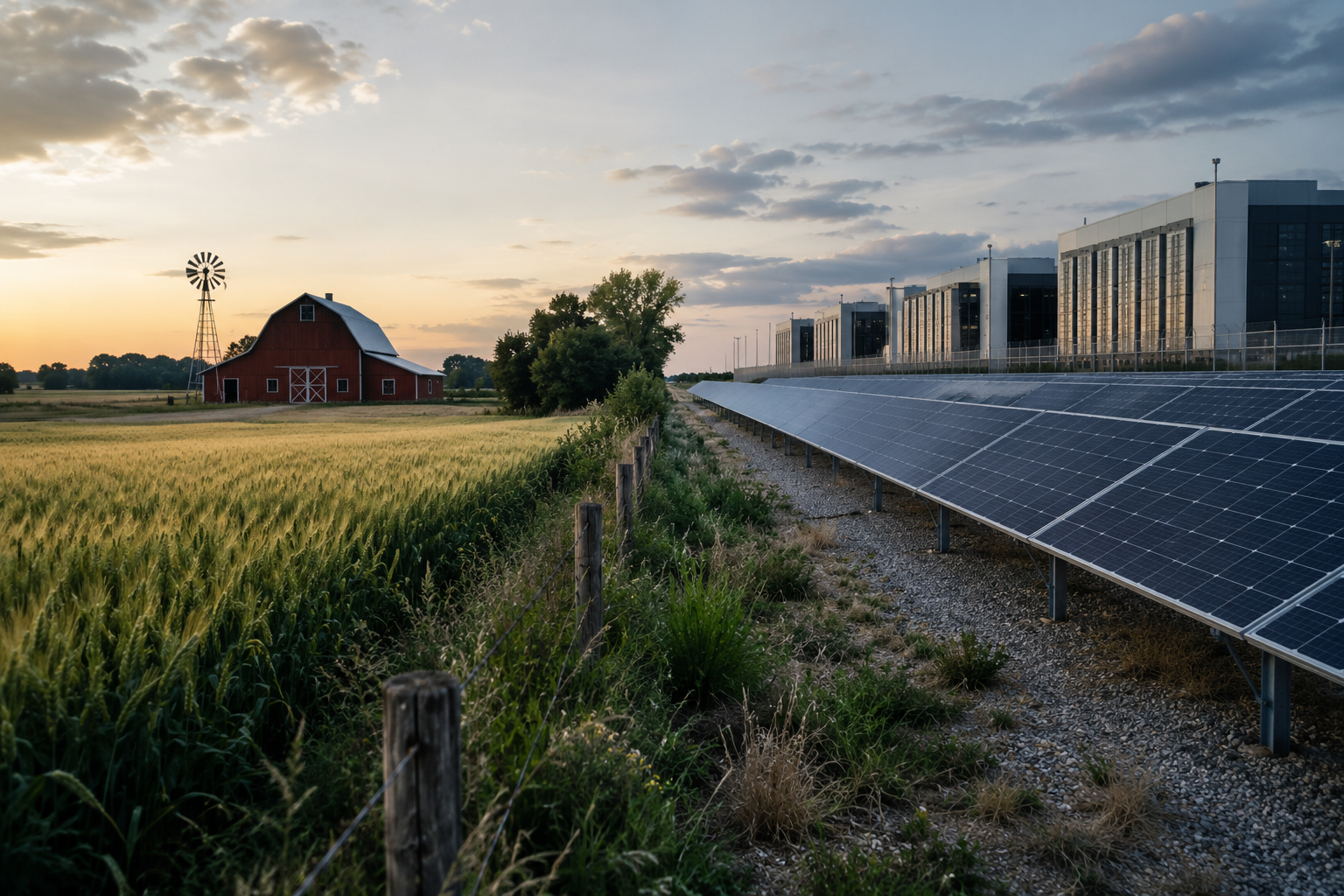
For generations, the people of Kansas have been defined by its working landscapes. Wheat fields, cattle pastures, hay meadows, wetlands, shelterbelts, and family farms have shaped both the economy and identity of rural communities. Today, however, a new land-use debate is emerging across the state as large solar installations and data centers compete with agriculture for land, water, and infrastructure.
Many rural residents are asking a simple question: If land must be changed, why not keep it in agriculture?
The answer is not necessarily that agriculture is perfect. Modern farming can cause erosion, habitat loss, water pollution, and declining biodiversity. Yet many Kansans still view agricultural land use as fundamentally different from industrial development because farming remains tied to natural ecological processes in ways that solar farms, warehouses, and data centers often do not.
Agriculture Is Temporary
One of the most important distinctions between farming and industrial development is permanence.
A wheat field can become native prairie. A pasture can be restored to wetlands. An orchard can be removed and replanted. Agricultural land typically remains biologically active and can transition between different uses over time.
Industrial developments often create a more permanent transformation. Data centers require extensive infrastructure, roads, transmission lines, buildings, cooling systems, and utility connections. Even after a facility reaches the end of its useful life, the site may remain heavily altered.
While some solar farms can eventually be removed, they often require decades-long commitments, extensive fencing, grading, and substantial electrical infrastructure that can alter how the land functions and how people interact with it.
Agricultural landscapes remain comparatively flexible.
Farms Can Coexist with Habitat
Historically, the Great Plains supported vast grasslands, wetlands, and wildlife populations. Agriculture replaced much of that native habitat, but many agricultural systems still support ecological functions.
Pastures provide grass cover for birds and pollinators. Shelterbelts offer nesting sites and wind protection. Farm ponds create aquatic habitat. Hay meadows can support insects and ground-nesting wildlife. Agroforestry systems can produce food while increasing biodiversity.
Even conventional cropland often remains biologically permeable. Deer move through fields. Pollinators visit flowering crops. Migratory birds forage in harvested fields.
This does not mean agriculture is harmless. It means that agricultural land can still function as part of a larger ecological landscape.
In contrast, many industrial land uses are designed primarily for infrastructure rather than biological productivity.
Agriculture Produces Food
Another factor influencing public opinion is that farms directly produce food, fiber, and other biological resources.
A productive farm generates calories, livestock feed, fuel crops, medicines, fibers, fruits, vegetables, and habitat management opportunities. These outputs are essential for human survival.
Solar farms produce electricity, which is also important. Data centers provide digital services that increasingly power modern economies. Yet many rural residents view food production as a more fundamental use of land than digital infrastructure.
In communities where agriculture has been the economic foundation for generations, replacing food-producing acreage with industrial facilities can feel like a loss of local identity and resilience.
Rural Economies Were Built Around Agriculture
Kansas towns grew around agricultural production. Grain elevators, feed stores, equipment dealers, seed suppliers, veterinarians, and local processors all depend on active farms.
When farmland is converted to industrial uses, some communities worry that economic activity becomes concentrated in fewer hands. A solar installation may employ relatively few long-term workers once construction is complete. Data centers can generate tax revenue but often create fewer permanent jobs than many people expect.
Agriculture, despite its challenges, continues to support a network of local businesses throughout rural Kansas.
The Conservation Opportunity
The debate should not be framed as agriculture versus conservation.
The most promising future may involve regenerative agricultural systems that restore ecological function while producing food. Native grass buffers, wetland restoration, agroforestry, rotational grazing, pollinator habitat, and perennial crops can help reconnect farming with the natural systems that once dominated the Great Plains.
Kansas does not need to choose between economic productivity and ecological health. The challenge is designing land uses that accomplish both.
If a landscape can produce food, support wildlife, recharge groundwater, reduce erosion, and strengthen rural communities, it offers benefits that extend beyond any single industry.
Looking Forward
The conversation about solar farms, data centers, and agricultural land is ultimately a conversation about the future of Kansas.
Every land use has costs. Agriculture has transformed ecosystems and contributed to environmental challenges. Industrial developments provide services and economic opportunities that modern society depends upon.
Yet many Kansans continue to favor agricultural landscapes because they remain connected to the living systems of the prairie. Crops grow, soils change, wildlife moves through the landscape, and future generations retain the ability to reshape the land.
The question is not whether agriculture is perfect. The question is whether future development should strengthen or weaken the relationship between people, food, and the natural systems that sustain both.
For many rural communities, the answer remains clear: working landscapes should continue to work with nature whenever possible.