
Why Does Bugs Bunny Dig?
For many people in North America, one of the strangest things about Bugs Bunny isn't that he talks, tricks hunters, or munches carrots, it's that he lives in a burrow.
After all, the rabbits most North Americans see in their yards, fields, and roadsides don't spend their days digging elaborate underground tunnel systems. So why does Bugs Bunny live underground?
The answer lies in the fascinating diversity of rabbits around the world.
The Rabbit That Inspired Bugs Bunny
Bugs Bunny was created by American animators, but the rabbit they imagined behaves much more like a European rabbit than the rabbits most people encounter in North America.
The European rabbit (Oryctolagus cuniculus) is famous for digging extensive underground tunnel systems called warrens. These warrens can contain multiple entrances, nesting chambers, escape routes, and entire colonies of rabbits living together beneath the ground.
This behavior evolved as protection from predators and harsh weather. Living underground allows rabbits to avoid foxes, birds of prey, and temperature extremes while raising their young in relative safety.
In Europe, seeing rabbits emerge from burrows is completely normal. In much of North America, however, it is not.
Why Most North American Rabbits Don't Dig
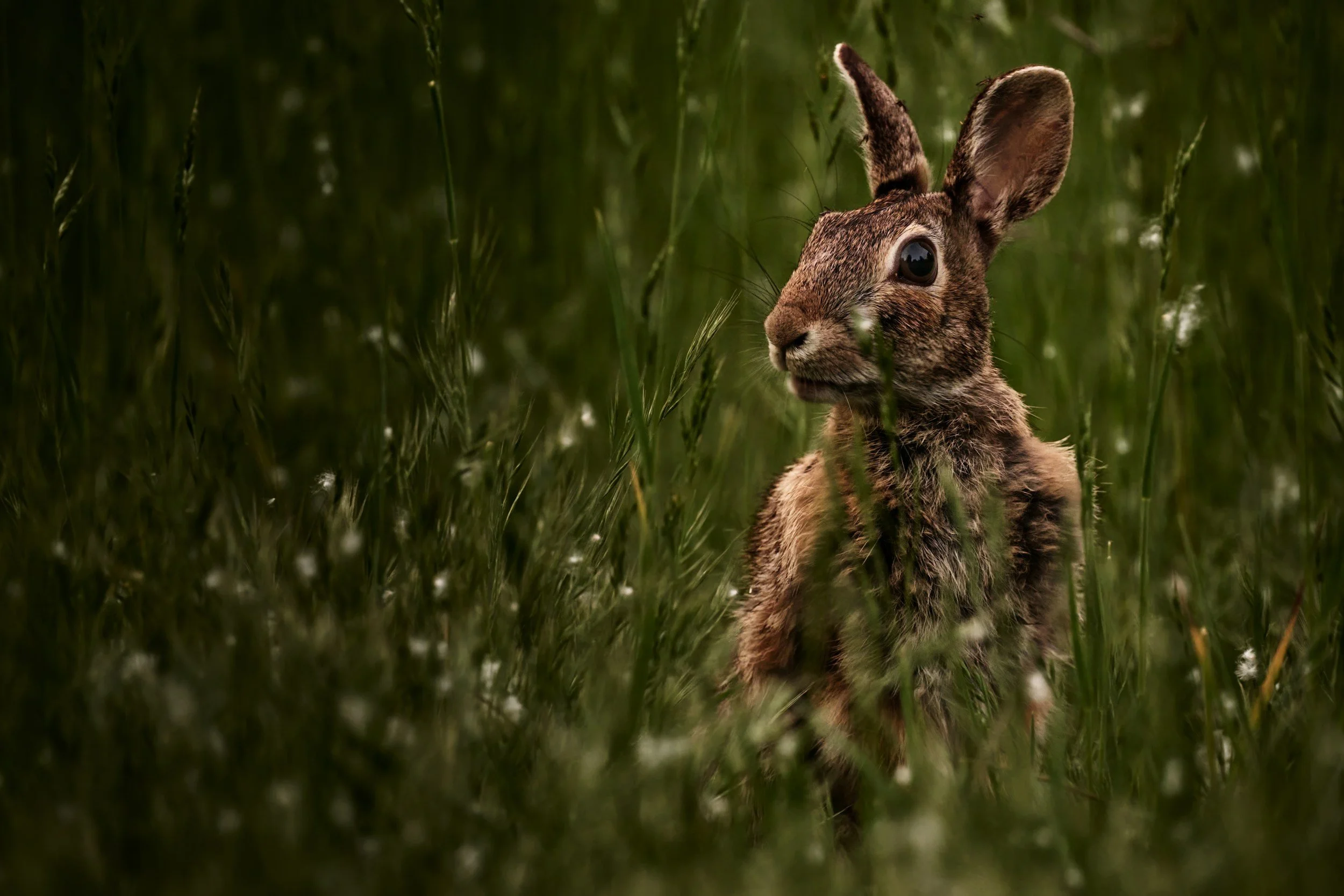
Most rabbits in North America belong to a different group known as cottontails (Sylvilagus species).
Unlike European rabbits, cottontails generally do not excavate extensive burrows. Instead, they rely on camouflage, dense vegetation, speed, and concealment.
Many cottontails create only shallow depressions in the ground called forms, often hidden beneath grasses, shrubs, or brush piles. Their nests are typically small chambers lined with fur and vegetation rather than large underground tunnel systems.
This strategy evolved because many North American habitats historically contained abundant tall grasses, brushlands, forests, and thickets that provided excellent cover without requiring extensive digging.
When danger approaches, a cottontail's first defense is usually to freeze. If discovered, it explodes into a zig-zag sprint rather than retreating underground.
Digging Rabbits vs. Non-Digging Rabbits
Neither strategy is inherently better, they simply evolved in different environments.
Digging Rabbits
Advantages:
Protection from predators
Stable temperatures underground
Safe nursery sites
Ability to live in large colonies
Disadvantages:
Significant energy required to dig and maintain burrows
Burrows can flood
Colonies may attract predators
Rabbits become tied to a fixed location
Non-Digging Rabbits
Advantages:
Less energy spent on excavation
Greater mobility
Ability to quickly colonize new areas
Flexibility in changing environments
Disadvantages:
Greater exposure to weather
More vulnerable young
Increased reliance on vegetation for protection
These two strategies represent different solutions to the same evolutionary challenge: how to survive as a small, highly edible herbivore.
The Incredible Diversity of Rabbits
Many people think of "the rabbit" as a single animal, but there are dozens of rabbit and hare species spread across Europe, Asia, Africa, and North America.
North America
North America hosts remarkable rabbit diversity, including:
Eastern Cottontail
Desert Cottontail
New England Cottontail
Mountain Cottontail
Marsh Rabbit
Swamp Rabbit
Pygmy Rabbit
Snowshoe Hare
Black-tailed Jackrabbit
White-tailed Jackrabbit
The tiny Pygmy Rabbit of the western United States is particularly unusual because it is one of the few North American rabbits that regularly digs its own burrows.
Europe
Europe's native rabbit diversity is relatively low compared to North America.
The dominant species is the European Rabbit, whose digging behavior transformed ecosystems across the continent. Its success was so great that humans later introduced it around the world, including Australia, where it became one of history's most destructive invasive mammals.
Europe also contains several hare species, which generally do not live in warrens.
Asia
Asia possesses some of the world's greatest rabbit diversity.
Species include:
Tolai Rabbit
Japanese Rabbit
Amami Rabbit
Chinese Hare
Arctic Hare populations in northern regions
Numerous mountain and forest rabbits
Asian rabbits occupy environments ranging from tropical islands and dense forests to deserts, steppes, and alpine mountains. Some are highly social, while others live solitary lives.
The Amami Rabbit of Japan is often considered a living relic, representing an ancient branch of rabbit evolution unlike most species alive today.
So Why Does Bugs Bunny Dig?
The simplest answer is that Bugs Bunny is a blend of rabbit traditions.
His underground home reflects the behavior of the European rabbit, the world's most famous burrow-building rabbit. Yet the character became popular in North America, where most people are familiar with cottontails that rarely dig extensive tunnels.
As a result, Bugs Bunny's burrow can seem a little strange to American audiences—especially those who grew up watching eastern cottontails dart through fields and gardens rather than disappear into underground warrens.
In reality, both lifestyles are perfectly normal in the rabbit family.
Whether hiding in a grassy thicket, racing across a prairie, or disappearing into a complex underground warren, rabbits have evolved a remarkable variety of strategies for surviving in nearly every habitat of the Northern Hemisphere.
The next time Bugs Bunny ducks underground after outsmarting Elmer Fudd, remember: he's behaving exactly like one kind of rabbit. Even if he's not acting much like the rabbits in your backyard.