

Natural Thinning in Forests and Shelterbelts
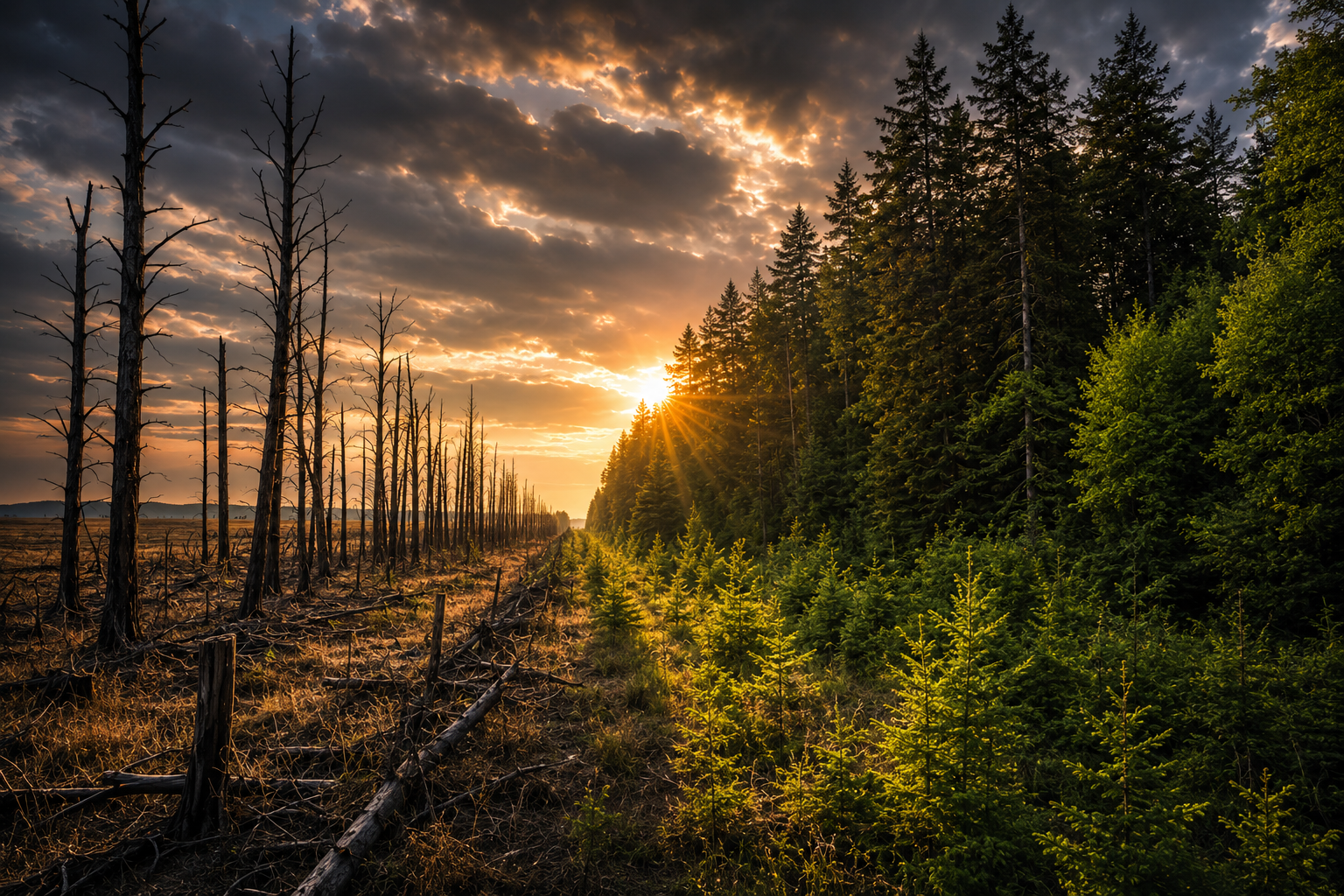
An artistic rendered image showing a dead forest next to a living one that is being restored
When to Intervene and When to Let Nature Work
Forests are not static systems. Trees grow, compete, reproduce, and die in an ongoing process that shapes ecosystems across decades and centuries. One of the most important and often misunderstood parts of this process is natural thinning.
Natural thinning occurs when some trees die as competition for sunlight, water, nutrients, and space increases. While the loss of trees can sometimes alarm landowners, conservationists, or community members, natural thinning is often a normal and healthy part of forest development. In other situations, however, thinning can reduce important functions such as wind protection, wildlife habitat, erosion control, or scenic value, making active management necessary.
Understanding when natural thinning is beneficial and when intervention is needed is key to maintaining healthy forests and effective shelterbelts.
Why Forests Naturally Thin
In young forests, thousands of seedlings may emerge on a single acre. As these trees grow, competition intensifies. Some individuals become dominant while others are shaded, weakened, and eventually die.
This process serves several ecological functions:
Reduces overcrowding.
Allows surviving trees to grow larger and stronger.
Creates dead wood habitat for insects, fungi, birds, and mammals.
Opens gaps that encourage regeneration.
Increases structural diversity within the forest.
Natural thinning is one reason mature forests often contain fewer trees per acre than young forests, despite having much greater biomass.
When Natural Thinning Becomes a Problem
Although thinning is natural, it can become problematic when it compromises the intended function of a forest or shelterbelt.
Windbreak and Shelterbelt Failure
Many Great Plains shelterbelts were planted during the twentieth century to reduce wind erosion, protect crops, and provide wildlife habitat.
As shelterbelts age, several issues can arise:
Large trees die without replacement.
Lower branches disappear, creating gaps near the ground.
Entire rows become overmature simultaneously.
Insect outbreaks or drought accelerate mortality.
Even if a shelterbelt still contains large trees, its effectiveness as a windbreak may decline if density drops too low.
A windbreak functions best when it slows wind without creating large openings. Excessive thinning can allow wind to pass through, reducing protection for fields, livestock, roads, and homes.
Wildlife Habitat Loss
Many wildlife species depend on dense woody cover.
Natural thinning can reduce:
Nesting sites for songbirds.
Winter thermal cover.
Escape cover from predators.
Shrub layers used by pollinators and small mammals.
In some situations, maintaining habitat function may require supplemental planting long before the original trees begin to fail.
Recreation and Tourism Concerns
Forests valued for recreation, birdwatching, hunting, scenic drives, or tourism may suffer when large areas experience decline.
Visitors often notice:
Dead canopy trees.
Open gaps.
Reduced fall color displays.
Loss of shade along trails.
While ecological succession may still be proceeding normally, public perception and economic value can be affected.
When Natural Thinning Is a Sign of a Healthy Ecosystem
Not all thinning should be viewed as degradation.
In many forests, thinning signals progression toward a more mature and resilient ecosystem.
Indicators of healthy natural thinning include:
Diverse age classes.
Natural regeneration beneath the canopy.
Presence of seedlings and saplings.
Standing dead trees (snags).
Fallen logs supporting fungi and wildlife.
Increasing structural diversity.
A forest transitioning from a dense young stand into a mature woodland may appear less crowded while actually becoming more ecologically valuable.
Pioneer Species vs. Successional Species
Successful reforestation requires understanding how different trees establish themselves.
Pioneer Species
Pioneer species are adapted to disturbed environments.
They thrive where:
Soil has been exposed.
Sunlight reaches the ground.
Competition is limited.
Examples across much of North America include:
Cottonwoods
Aspens
Willows
Many pines
Eastern redcedar in open landscapes
These species often grow rapidly but may have shorter lifespans and lower shade tolerance.
When reforesting open fields, abandoned farmland, or heavily disturbed sites, pioneer species frequently establish most successfully.
Successional and Shade-Tolerant Species
Successional species often establish beneath existing forests.
Rather than requiring disturbance, they are adapted to growing under partial shade.
Examples include:
Oaks
American basswood
Pawpaw
American beech
Sugar maple
Spicebush
Many understory shrubs
These species can often be planted directly beneath existing canopies with high survival rates.
In many mature forests, the next generation is already growing beneath the current one long before canopy trees die.
Two Paths to Forest Thickening and Reforestation
Forest restoration can favor either pioneer species or successional species depending on management goals.
Strategy 1: Disturbance-Based Regeneration
This approach favors pioneer species.
Methods include:
Clearings and gap creation.
Prescribed fire.
Selective harvest.
Removal of invasive plants.
Soil scarification.
Benefits:
Rapid establishment.
Fast growth.
Quick windbreak recovery.
Increased sunlight.
Drawbacks:
Higher weed pressure.
Greater moisture stress.
Potential erosion.
This strategy works particularly well for cottonwoods, willows, aspens, and many sun-loving species.
Strategy 2: Underplanting Existing Forests
This approach favors successional species.
Methods include:
Planting beneath existing canopies.
Protecting seedlings from deer browsing.
Managing invasive understory plants.
Small-scale canopy openings.
Benefits:
Reduced temperature extremes.
Improved soil moisture retention.
Lower weed competition.
Preservation of existing habitat.
This strategy is ideal when maintaining continuous forest cover is important.
Rebuilding Aging Shelterbelts
Many shelterbelts can be rejuvenated without complete removal.
Effective approaches include:
Staggered Replacement
Plant new trees before old trees die.
This creates overlapping generations and avoids sudden windbreak failure.
Filling Gaps
Replace missing individuals as soon as gaps appear.
Even a few openings can significantly reduce windbreak performance.
Diversification
Avoid relying on a single species.
Mixed plantings improve resilience against:
Disease
Insects
Drought
Extreme weather
Layered Design
Healthy shelterbelts often contain:
Tall canopy trees
Midstory trees
Shrubs
Herbaceous vegetation
Multiple layers improve wildlife value and wind reduction.
Matching Species to the Landscape
Different landscapes require different restoration approaches.
Open Agricultural Landscapes
Prioritize:
Fast-growing pioneers
Wind-resistant species
Drought-tolerant trees
Mature Forests
Prioritize:
Shade-tolerant species
Understory regeneration
Structural diversity
Riparian Corridors
Prioritize:
Cottonwoods
Willows
Wetland shrubs
These systems naturally experience periodic disturbance and benefit from dynamic regeneration.
Urban Forests
Prioritize:
Long-lived species
Diverse age classes
Public safety
Aesthetic value
Keys to Successful Forest Thickening
Regardless of location, several principles consistently improve outcomes:
Plant before decline becomes severe.
Match species to light conditions.
Protect young trees from grazing and browsing.
Use multiple species whenever possible.
Maintain healthy soils and leaf litter.
Encourage natural regeneration where available.
Monitor canopy gaps and replace lost trees early.
Think in decades rather than years.
Working With Succession Instead of Against It
The most successful restoration projects recognize that forests are living systems, not static landscapes.
Natural thinning is neither inherently good nor bad. It is a process. The question is whether that process continues to support the goals of the land.
If a shelterbelt is losing its ability to stop wind, intervention may be necessary. If a mature woodland is naturally transitioning toward greater diversity and complexity, allowing succession to proceed may be the best choice.
By understanding the differences between pioneer and successional species, and by matching restoration methods to ecological conditions, landowners can rebuild forests, strengthen shelterbelts, improve wildlife habitat, and create landscapes that remain productive and resilient for generations to come.